Jellyfish vs CloudByte PMS
Jellyfish measures the engineering org top-down. CloudByte PMS measures AI coding bottom-up — at the session, developer, and pull-request level.
Jellyfish and CloudByte PMS both help engineering leaders make decisions with data — but they answer different questions. Jellyfish is an engineering management platform built for allocation, R&D capitalization, and delivery metrics. CloudByte PMS is an AI telemetry platform built to show what your developers actually do with AI coding tools like Claude Code.
If your question is “how is our engineering investment split, and are we shipping?”, Jellyfish is the broader fit. If your question is “is our AI coding spend producing more shipped work, and which developers benefit?”, that is exactly what CloudByte PMS is built to measure — down to the individual session and merged pull request.
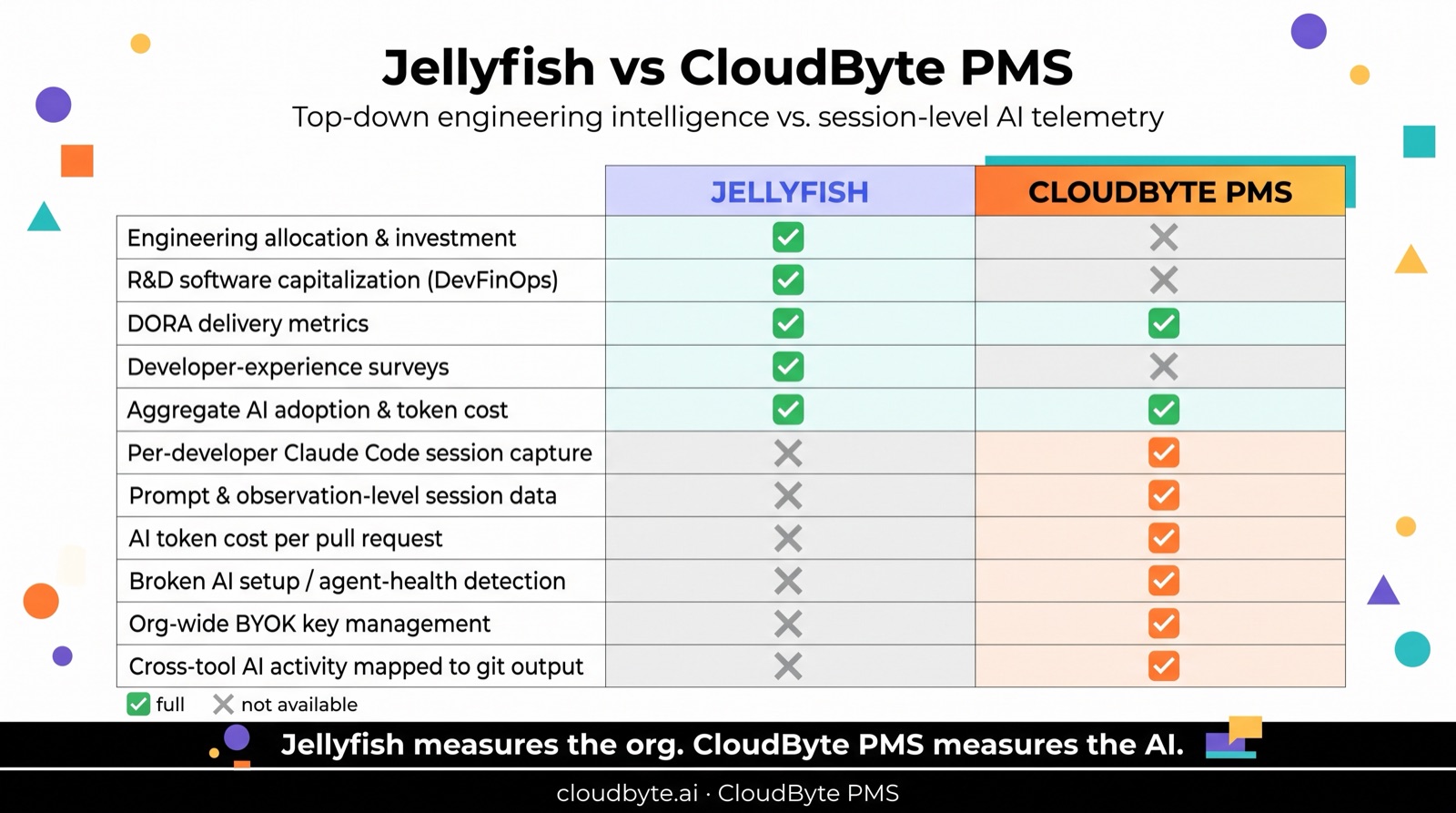
What is Jellyfish built for?
Jellyfish is an engineering management platform aimed at engineering and finance leadership. Its patented allocations model maps where engineering effort goes; its DevFinOps module automates R&D software capitalization; and it reports DORA-style delivery metrics and developer-experience survey data. It integrates with Jira, git providers, and calendar/finance/HR systems to contextualize engineering work against business goals.
Jellyfish has also added an “AI Impact” product line that reports aggregate AI adoption and token cost. It is a real capability — but it operates at the portfolio level, not the individual developer session.
Where CloudByte PMS goes deeper: session-level AI telemetry
CloudByte PMS captures each Claude Code session in the developer's environment — prompts, observations, token usage, and outcomes — then maps that activity to git output. That session-level foundation unlocks data an aggregate dashboard cannot produce:
- Per-developer adoption & activity. Claude Code usage analytics and real-time developer insights show who is actually using AI, not just seat counts.
- Measured productivity, not vibes. AI productivity measurement correlates AI activity with merged PRs and review cycles to reveal real multipliers by work type.
- Per-PR cost & BYOK. BYOK for Anthropic Claude keeps billing on your key while CloudByte PMS attributes token cost to individual pull requests.
- Operational health. Agent-health monitoring catches broken or stale Claude Code setups before they quietly waste licenses.
- DORA delivery metrics — correlated with AI. CloudByte PMS also reports DORA-style delivery metrics and pairs them with AI activity, so you see delivery and the AI input behind it together — see DORA metrics vs AI activity.
- Commits, security & governance. AI commit & code-review analytics, AI DLP to stop secrets leaking into AI tools, and prompt governance via a shared skills library round out the picture.
Jellyfish vs CloudByte PMS: capability comparison
| Capability | Jellyfish | CloudByte PMS |
|---|---|---|
| Engineering allocation & investment analysis | ||
| R&D software capitalization (DevFinOps) | ||
| DORA delivery metrics | ||
| Developer-experience surveys | ||
| Aggregate AI adoption & token cost (AI Impact) | ||
| Per-developer Claude Code session capture | ||
| Prompt & observation-level session data | ||
| AI token cost attributed per pull request | ||
| Broken AI setup / agent-health detection | ||
| Org-wide BYOK key management across providers | ||
| Cross-tool AI activity mapped to git output per developer |
Jellyfish tells leadership how the engineering org is investing and delivering. CloudByte PMS tells you what each developer is actually doing with AI — and whether that spend ships work.
When should you choose Jellyfish vs CloudByte PMS?
Choose Jellyfish when your primary need is engineering-to-finance alignment: R&D capitalization, headcount and initiative allocation, and board-level delivery reporting across a large org.
Choose CloudByte PMS when your primary need is understanding and governing AI coding: per-developer adoption, per-PR cost, ROI of Claude Code and other AI tools, broken-setup detection, and secrets protection.
Run both when you want the complete picture — Jellyfish for delivery and investment, CloudByte PMS for the AI input driving that delivery.